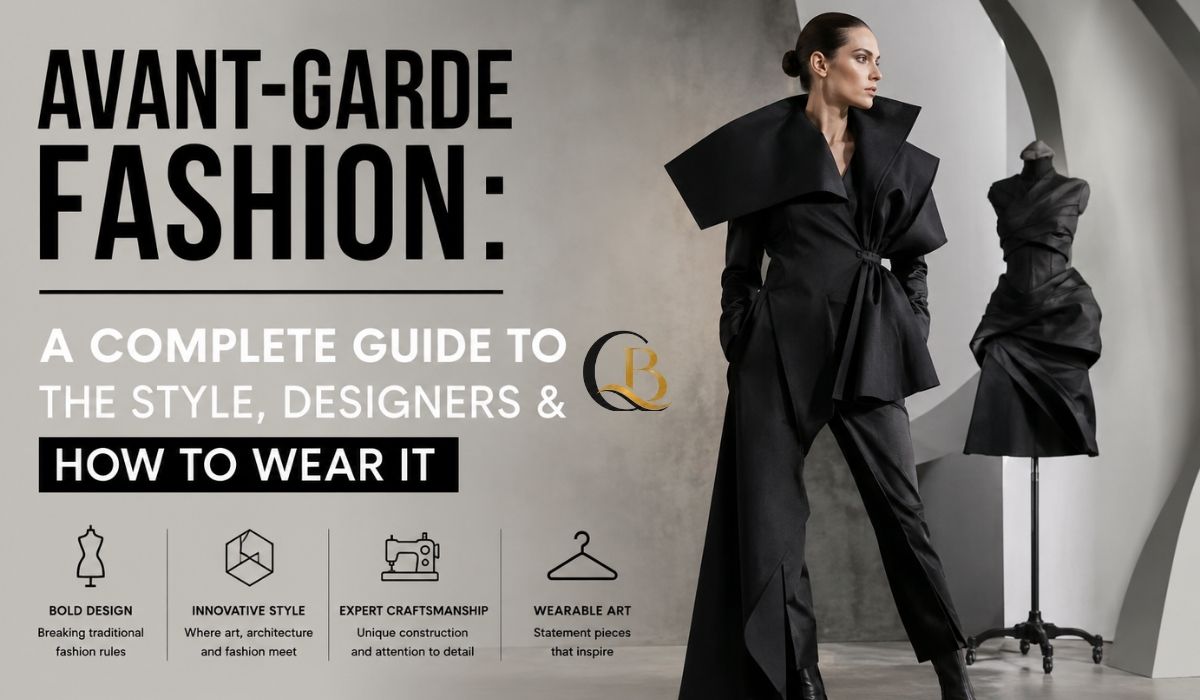

Most explanations of avant-garde fashion stop at “experimental” and “boundary-pushing,” which tells you nothing useful if you’re standing in your closet trying to figure out whether that asymmetric coat is a good buy. Avant-garde fashion is clothing designed to question the accepted rules of construction, silhouette, or purpose — not just clothing that looks unusual. Once you understand it as a design philosophy rather than a look, building a wardrobe around it stops feeling like guesswork.
This guide breaks down what separates genuine avant-garde design from costume-y “weird for the sake of weird,” walks through the major design philosophies with real examples, and gives you a practical path for wearing this stuff in an actual life that includes commuting, work meetings, and stairs.
What Is Avant-Garde Fashion, Really?
The term borrows from the French military phrase for the “advance guard” — the unit that moves ahead of the main army into unknown territory. In fashion, that translates to designers who move ahead of commercial trends, often by rejecting the basic assumptions the rest of the industry works from: that a jacket has two symmetrical sleeves, that a hemline sits at a predictable height, that clothing should flatter the body’s existing shape.
That’s the part most articles skip. Avant-garde design isn’t defined by a color palette (though black dominates) or a silhouette (though oversized and deconstructed shapes recur). It’s defined by what assumption it’s breaking. A garment that removes the shoulder seam, or turns the lining into the visible exterior, or builds volume that has nothing to do with anatomy — that’s the avant-garde move. Whether it also happens to look strange is a side effect, not the point.
Avant-Garde vs. High Fashion vs. Streetwear
People conflate these constantly, so here’s the distinction that actually holds up:
| Category | Primary Goal | Relationship to Rules |
|---|---|---|
| High fashion / haute couture | Craftsmanship, exclusivity, luxury signaling | Works within established rules, executes them at the highest level |
| Streetwear | Cultural identity, hype, community | Remixes existing garment types, rarely alters construction logic |
| Avant-garde | Conceptual challenge to design conventions | Actively breaks or reinvents construction rules |
A $4,000 hand-embroidered gown can be exquisite couture without being avant-garde at all if it follows conventional tailoring logic. Meanwhile, a $60 deconstructed t-shirt with an inside-out seam and a raw hem can be genuinely avant-garde in intent even if it’s cheap. Price and experimentation aren’t the same axis.
The Three Design Philosophies Worth Knowing
Instead of listing designer names with no context, here’s how to actually tell design philosophies apart — because “avant-garde” covers at least three different approaches that don’t look alike at all.
1. Deconstruction — clothing that shows its own making
This philosophy exposes seams, leaves edges raw, and turns the “wrong side” of fabric into the visible side. Comme des Garçons under Rei Kawakubo built an entire body of work on this idea starting in the 1980s, famously showing garments with intentional holes and asymmetry that Paris critics initially dismissed as “Hiroshima chic” — a reaction that says more about Western fashion’s assumptions than about the clothes themselves.
2. Sculptural volume — clothing as architecture
Here the body becomes an armature for a shape, not the source of the shape. Rick Owens’ draped, cocoon-like silhouettes and Iris van Herpen’s 3D-printed, almost biological forms both fall here, even though their visual results couldn’t be more different. The test isn’t “does it look like a sculpture” — it’s whether the garment’s volume is dictated by an external idea rather than by fitting a torso.
3. Anti-fit and proportion distortion
This philosophy keeps garments recognizable — you can still call it a coat, a trouser — but radically shifts where things sit on the body. Dropped crotches, sleeves that extend past the fingertips, waistlines at the hip instead of the natural waist. Martin Margiela’s oversized, borrowed-from-menswear tailoring for women is a classic example of proportion distortion used to make a point about gender and scale rather than shock for its own sake.
Knowing which philosophy a piece belongs to helps you predict how it’ll actually behave on your body, which matters more than any brand name when you’re deciding whether to buy it.
Is Avant-Garde Fashion Actually Wearable?
Here’s the honest answer: some of it, no. Runway pieces are frequently built as concept statements, not retail products — a coat with a six-foot train isn’t going through airport security with you, and that’s fine, because that was never its job. Confusing runway pieces with the wearable, retail versions of a designer’s line is where most of the “this is impractical nonsense” criticism comes from, and the criticism is fair for that specific confusion, even if it misjudges the category as a whole.
What actually reaches stores and secondhand racks is almost always a toned-down translation: the deconstructed seam without the runway-only proportions, the sculptural shoulder in a jacket you can still sit down in. If you’ve only seen avant-garde fashion in magazine spreads from fashion week, you’ve seen the 5% that’s designed to be photographed, not worn. The other 95% is quieter, and it’s the part worth shopping.
Common Misconceptions, Addressed Directly
- “It’s just black clothes with weird cuts.” Black dominates because it doesn’t compete visually with unusual construction — but van Herpen’s work is often translucent and colorful, and 1990s Junya Watanabe used loud prints extensively. Color absence is a common choice, not a requirement.
- “You need a fashion-industry body to wear it.” Anti-fit and sculptural philosophies were specifically developed to de-emphasize the body underneath. Oversized and asymmetric shapes tend to work on a wider range of body types than fitted, conventional tailoring does, not a narrower one.
- “It’s only for people with unlimited budgets.” True at the runway/couture level. Not true at the diffusion-line, resale, or independent-designer level — see the buying section below.
How to Actually Start Wearing Avant-Garde Pieces
If you want to try this without your first purchase being a $2,000 misstep, work from the outside in.
- Start with one distorted proportion, not three. Pick a single element — an oversized sleeve, a dropped shoulder, an asymmetric hem — and pair it with genuinely plain basics. A wide-leg, dropped-crotch trouser reads as intentional against a plain fitted tee; the same trouser against three other loud pieces reads as costume.
- Buy secondhand and archive pieces first. Platforms like Grailed, Vestiaire Collective, and The RealReal have made archival Margiela, early Comme des Garçons, and Yohji Yamamoto pieces far more accessible than they were a decade ago, often at 60-80% below original retail. This is genuinely the biggest shift in how people access this aesthetic since the designs themselves debuted — it used to require flagship-boutique money; now it mostly requires patience and search skills.
- Learn to style down, not just style up. A structurally interesting jacket doesn’t need interesting shoes, bag, and jewelry to “complete” the look. Often it needs the opposite — sneakers, no jewelry, so the garment’s construction stays the focal point.
- Try a diffusion or bridge line before the mainline. Comme des Garçons PLAY, Y-3, and MM6 Maison Margiela translate the parent house’s ideas into more affordable, more wearable pieces. They’re a legitimate entry point, not a “lesser” version — think of them as the everyday-language version of a more academic text.
- Accept that some pieces are meant to be occasional, not everyday. A sculptural coat you wear four times a season isn’t a failed purchase. Treating every garment as if it needs daily rotation is a fast-fashion mindset applied to a category that doesn’t operate on that logic.
Where the Style Sits Today
Avant-garde fashion has spent the last several years moving from a niche subculture into something visible in mainstream celebrity styling and social platforms, which has pushed prices up on certain archive pieces and pulled some diffusion lines toward safer, more sellable silhouettes. That tension — between a philosophy built on resisting commercial norms and a market that inevitably commercializes anything popular — isn’t new, and it isn’t going away. It’s worth knowing about before you invest heavily in any one label, because the pieces that hold their conceptual integrity best tend to be the ones from designers still actively pushing their own construction ideas forward, not resting on a recognizable silhouette from a decade ago.
The Bottom Line
Avant-garde fashion rewards people who treat it as a set of ideas about how clothing can be built, not a costume box to raid for shock value. Start with one broken rule at a time, buy into the idea before you buy into the hype, and don’t feel obligated to wear runway-level pieces the way they were shown. The version of this aesthetic that actually lives in people’s closets is quieter, more wearable, and more interesting than the headlines about it suggest.
If you’re ready to shop, start by identifying which of the three philosophies above actually appeals to you — deconstruction, sculptural volume, or anti-fit — and search resale platforms using designer names tied to that specific approach rather than the generic term “avant-garde,” which tends to surface overpriced, low-quality knockoffs before it surfaces the real thing.
Suggested Internal Linking Opportunities
- A guide to building a capsule wardrobe around neutral, deconstructed basics
- An explainer on shopping designer resale platforms safely (authentication, sizing, return policies)
- A profile-style piece on minimalist vs. maximalist fashion philosophies
Suggested External Sources
- Link to a museum or institutional fashion archive (e.g., a major costume institute’s online collection) for historical context on deconstructionist design
- Link to a reputable fashion resale platform’s size/authentication guide for readers new to buying archive pieces